
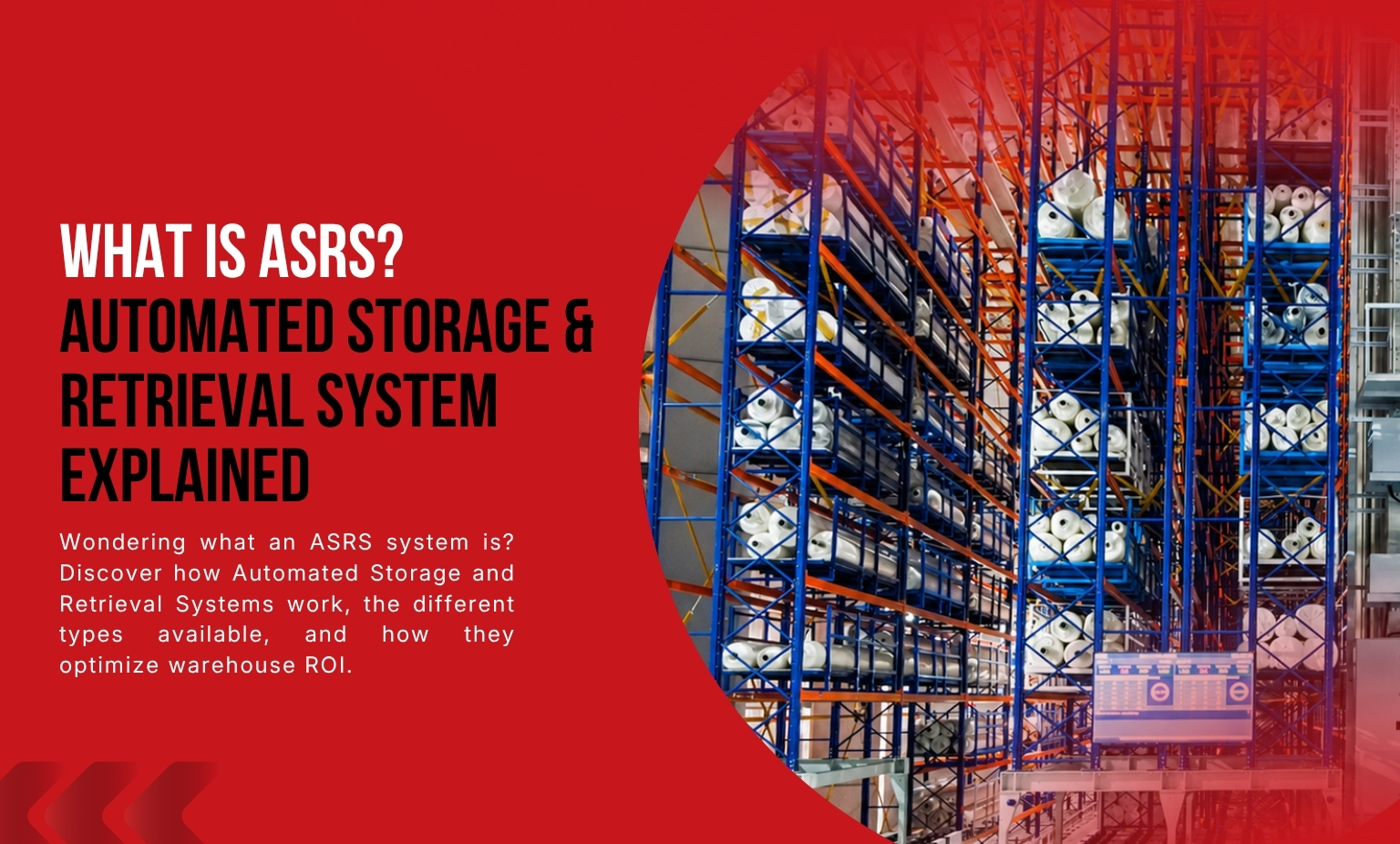
Warehouses today are under unprecedented pressure. With skyrocketing real estate costs, severe labour shortages, and consumer demands for rapid fulfilment, relying on manual inventory management is no longer a sustainable strategy for growth. If your facility is struggling with spatial constraints, picking errors, or sluggish throughput, you have likely encountered the term ASRS. But what exactly is ASRS, and how does it solve these modern intralogistics challenges?
This comprehensive guide covers everything you need to know about Automated Storage and Retrieval Systems, exploring how they work, the different types available, and why supply chain managers worldwide are integrating them into their smart factories.
An Automated Storage and Retrieval System (ASRS) is a computerized, robotic system that automatically places and retrieves goods from defined storage locations in a warehouse with precision, accuracy, and speed.
ASRS systems are a cornerstone of modern warehouse automation. They replace traditional shelving and manual forklift operations with high-density automated racking, shuttles, cranes, and advanced software. By moving inventory automatically, an ASRS eliminates the need for operators to walk aisles searching for items, a paradigm known as "goods-to-person" fulfilment.
An ASRS works by combining physical machinery (cranes, shuttles, carousels) with control software (WCS/WMS) to automatically transport inventory into storage slots and retrieve it upon receiving an order command.
When goods arrive at a facility, they are placed into standardized containers, trays, or pallets. The operator scans the item into the Warehouse Management System (WMS). The WMS determines the most strategic storage location based on demand frequency, weight, and dimensions.
See Sieger ASTOR's advanced warehouse control software and automated hardware in action. Request a demo today.
An effective ASRS relies on the seamless integration of three main components:
Storage Media: The physical racking or shelving structure. ASRS racking is typically much taller and denser than standard pallet racks, maximizing vertical storage.
Storage/Retrieval (S/R) Machines: The automated hardware such as stacker cranes, robotic shuttles, or inserter/extractor arms that physically moves the goods.
Software and Controls: The "brain" of the operation. The Warehouse Execution System (WES) or Warehouse Control System (WCS) directs the hardware, while integrating with the facility's over-arching WMS.
The main types of ASRS include Unit Load ASRS (for heavy pallets), Mini Load ASRS (for smaller bins/totes), Vertical Lift Modules (VLMs), Shuttle Systems, and Carousel Systems. Choosing the right type depends heavily on the size of the goods you are handling and the required throughput.
1. Unit Load ASRS
Designed to handle massive, heavy loads typically entire pallets weighing thousands of pounds. These systems use tall stacker cranes operating in narrow aisles.
Best for: Manufacturing companies storing raw materials or finished palletized goods.
2. Mini Load ASRS
Similar to Unit Load but scaled down to handle smaller loads like bins, trays, and cartons. They utilize lighter, faster cranes or shuttles.
Best for: Operations managers handling parts storage or preparing goods for order picking.
3. Vertical Lift Modules (VLM)
An enclosed system containing two columns of trays with an inserter/extractor mechanism in the centre. The VLM measures the height of items as they are stored to dynamically adjust shelf spacing, maximizing vertical cube space.
Best for: Facilities with high ceilings and small, valuable parts.
4. Shuttle Systems
A highly dynamic system using autonomous robotic shuttles that travel horizontally along tracks within the racking structure. They are known for incredibly high throughput.
Best for: E-commerce companies requiring rapid, high-volume order fulfilment.
To understand the value of ASRS, it helps to compare it directly to traditional warehouse operations.
| Feature | Traditional Manual Warehouse | Automated Storage and Retrieval System (ASRS) |
|---|---|---|
| Space Utilization | Low (Wide aisles required for forklifts) | Very High (Narrow aisles, leverages vertical space) |
| Picking Accuracy | Moderate (Prone to human error) | Extremely High (99.9% accuracy via software control) |
| Labour Dependency | High (Requires many operators walking aisles) | Low (Goods-to-person automation) |
| Throughput Speed | Limited by human physical constraints | Continuous, high-speed, 24/7 capability |
| Safety Risks | High (Forklift accidents, ergonomic strain) | Low (Operators remain stationary, machines handle heavy lifting) |
The primary benefits of ASRS include up to 85% space savings, significantly reduced labour costs, 99.9% inventory accuracy, enhanced worker safety, and faster order fulfilment.
Maximizes Floor Space: By utilizing vertical storage and eliminating wide forklift aisles, an ASRS can compress your storage footprint by up to 85%.
Combats Labour Shortages: ASRS mitigates reliance on a volatile labour market. It reallocates human workers from tedious walking and searching tasks to value-added roles.
Improves Inventory Control: Real-time software integration ensures you always know exactly what inventory you have and where it is located, eliminating "lost" items.
Enhances Ergonomics and Safety: Delivering goods at an ergonomically ideal height reduces bending, reaching, and lifting injuries for warehouse operators.
Virtually any industry dealing with physical inventory can benefit, but it is especially critical for:
E-commerce & Retail Chains: Handling massive SKU counts and next-day delivery expectations.
Food & Beverage: Managing strict expiration dates (FIFO/FEFO) and operating efficiently in cold-storage environments.
Manufacturing & Automotive: Ensuring a steady, just-in-time (JIT) supply of parts to the assembly line.
Pharmaceuticals: Requiring high security, temperature control, and complete traceability.
Expert Tip: Do not overbuy automation. Conduct a thorough data analysis of your current and projected throughput, SKU dimensions, and peak season demands before selecting a system.
Common Mistake: Failing to factor in software integration. Your ASRS hardware is only as good as the software driving it. Ensure the system integrates seamlessly with your existing ERP and WMS.
Conclusion
Automated Storage and Retrieval Systems are no longer a futuristic luxury; they are a competitive necessity. By transforming how inventory is stored and picked, an ASRS allows businesses to do more with less space, fewer manual resources, and unparalleled accuracy. Whether you are a 3PL provider looking to scale or a smart factory professional optimizing intralogistics, investing in the right ASRS is a strategic move toward future-proofing your supply chain. Ready to explore what ASRS can do for your facility? Contact the experts at Sieger ASTOR today.
26 August, 2025
18 July, 2025
Call or Chat +91 9894751798 or drop an email to [email protected]